Patients who want meaningful weight loss support are no longer choosing only between lifestyle changes and full bariatric surgery.
For many people, the more relevant question is whether there is a less invasive, medically supervised option in between. That stance has seen a massive rise in adaptation of endoscopic sleeve gastroplasty, or ESG.
ESG reduces stomach volume using an endoscope passed through the mouth, so it does not require the external incisions used in traditional gastric sleeve surgery. It offers a non-surgical, incision-free option that feels more medically substantial than a self-directed diet and exercise alone, while still sitting outside the world of conventional surgery.
In this article, we highlight five ESG weight-loss providers that stand out for readers looking for that middle ground. The goal is not to spotlight giant hospital systems, but to focus on providers that feel more service-led, accessible, and relevant to people comparing practical non-surgical treatment options.
For patients hoping to avoid traditional surgery, these are the kinds of providers that may feel especially worth knowing.
Firstly, what to look for in an ESG provider
Before comparing specific clinics, it helps to know what actually matters in an ESG provider. The procedure itself is important, but so is everything around it.
A strong provider should offer clear information about who ESG is best suited for, what the treatment involves, what recovery typically looks like, and how follow-up support is handled afterwards.
Clear eligibility guidance: A good provider should explain who ESG is suitable for and who may need a different treatment path.
Transparent procedure details: Readers should be able to understand how ESG works, what recovery involves, and what results may realistically look like.
Strong follow-up support: The best providers usually offer more than the procedure itself, with guidance around nutrition, lifestyle, and long-term progress.
A structured care approach: ESG tends to feel more credible when it is presented as part of a broader treatment plan, not a one-time fix.
Medical credibility without confusion: Look for clinics that communicate clearly, avoid exaggerated claims, and make the process easy to understand.
Realistic expectations: A trustworthy provider should frame ESG as a supportive tool, not an effortless shortcut.
Patient-centered communication: For many readers, the most reassuring providers are the ones that feel informative, responsive, and practical throughout the comparison process.
1. Everself
Everself is a non-surgical weight loss provider focused on endobariatric care, with ESG positioned not as a side offering, but as one of its core services.
That distinction matters for readers who already know they want to explore an incision-free, medically guided alternative before considering traditional bariatric surgery.
Rather than feeling like a broad hospital system where ESG sits among many unrelated specialties, Everself presents itself as a more focused, service-led option built around minimally invasive weight loss care.
Its appeal is fairly straightforward.
Patients considering ESG are often not looking for another vague wellness plan. They are looking for a meaningful next step that still feels less intimidating than surgery, but more structured than a self-directed diet and exercise alone.

That framing helps clarify the core USP: ESG is presented as a serious medical intervention without the incisions, hospital stay, or surgical intensity many patients are hoping to avoid.
Everself also stands out because its presence is not limited to one local market.
In addition to being a reliable non-surgical ESG weight loss solution in Dallas TX, it operates across multiple areas, including Miami, Washington DC and 10 other major cities, which helps reinforce the sense that it is a specialized provider with a broader footprint rather than a single-location clinic.
For readers comparing practical treatment options, that multi-market presence can add an extra layer of credibility while still preserving the more service-driven, patient-focused feel that smaller ESG providers often offer.
2. DFW Bariatrics and General Surgery
DFW Bariatrics and General Surgery is a strong comparison-point brand because it presents ESG as a minimally invasive, non-surgical procedure and emphasizes familiar patient concerns such as same-day discharge, low downtime, and a return to work within 24 to 48 hours.
Its service page also frames ESG as an “accordion procedure,” which may resonate with readers who have already started researching the treatment under different names.
Another reason it belongs on this list is clarity of positioning.
The practice explicitly describes ESG as a procedure performed from inside the stomach using endoscopic suturing, without the type of surgery many patients are trying to avoid.
It also presents the offering as part of a broader bariatric program, which can matter for readers who want procedural care plus physician follow-up rather than a one-off intervention.
3. LoneStar Bariatrics
LoneStar Bariatrics is another provider that fits this smaller-service-brand category well.
Its ESG page states that the procedure is performed by Dr. Chad Carlton and describes it as a minimally invasive weight-loss procedure that reduces stomach size without surgery.
The site also explains the mechanics clearly, noting that an endoscope and stitching device are used through the mouth to create a smaller, tube-like stomach.
That kind of patient-facing explanation is valuable because many people understand “gastric sleeve” more readily than “endoscopic sleeve gastroplasty.”
LoneStar helps bridge that gap without making the treatment sound overly technical. Its Dallas location page also describes ESG as an outpatient, non-surgical option with quick recovery and possible improvement in obesity-related conditions, which makes it especially relevant for readers comparing practical day-to-day recovery expectations.
4. DFW Bariatric Institute
DFW Bariatric Institute belongs in this roundup because it markets ESG directly to patients seeking non-surgical weight loss in Dallas and Fort Worth. They describe the procedure as incisionless, without stapling or external scarring, and clearly distinguishes it from traditional vertical sleeve gastrectomy by noting that no part of the stomach is removed.
That difference is often one of the biggest reasons patients look into ESG in the first place.
The practice also highlights quick recovery, candidate screening, financing information, and the role of healthy lifestyle changes after the procedure.
That combination of procedural access plus practical next-step information makes it feel like a service brand readers can actually evaluate, rather than a purely informational listing.
5. NYC Bariatrics
Although it is outside Texas, NYC Bariatrics is still a useful inclusion because it operates much more like a focused bariatric service brand than a massive academic center.
Their ESG page notes that the procedure has mainly been used in patients with mild to moderate obesity, especially those in the BMI 30 to 40 range, and it also acknowledges that durability may need to be supported with medical therapy over time.
That level of specificity makes the positioning feel more grounded than promotional.
The practice’s recent blog content also frames ESG as a no-surgery option for patients seeking less invasive care, which keeps it in the same general service category as the other providers listed here.
For readers comparing brands, that matters because the article stays focused on real-world ESG providers rather than drifting into major hospital systems that compete in a very different way.
Why ESG keeps appealing to patients who want to avoid surgery
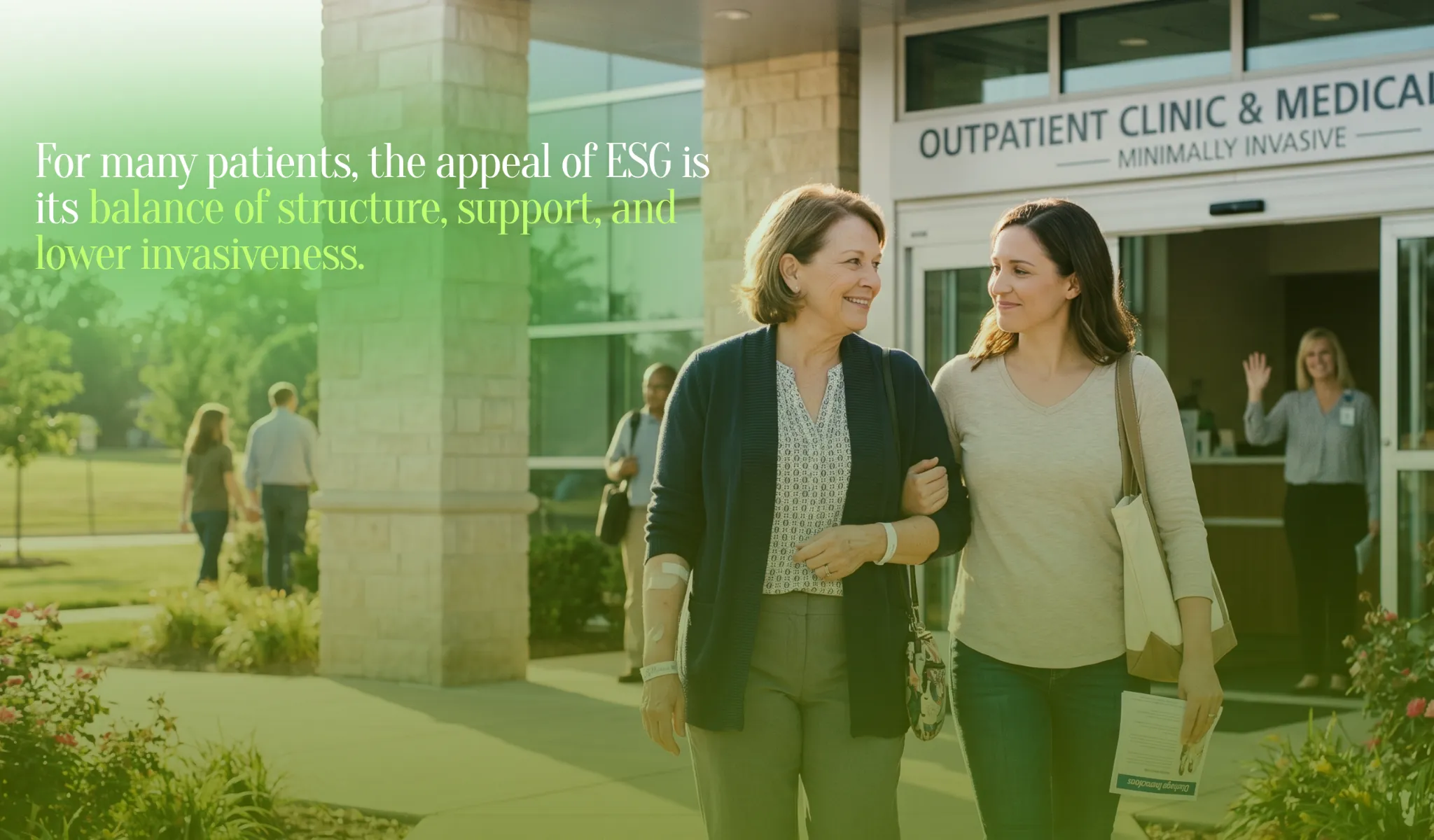
One reason ESG continues to appeal to many patients is that it offers a middle ground between self-directed weight loss efforts and traditional bariatric surgery.
For people who want meaningful medical support but feel hesitant about incisions, hospital stays, or a more invasive procedure, ESG can feel like a more approachable next step.
It is often seen as a way to access structured intervention without crossing fully into surgery, which makes it especially relevant for patients looking for something substantial but less intimidating.
People are comparing injections, obesity treatment plans, bariatric surgery, and newer non-surgical procedures all at once. ESG is not necessarily the right fit for every patient, but it is clearly becoming part of the conversation for those looking for a medically supported option that does not begin with traditional surgery.
The smartest ESG providers are not always the biggest names.
Often, they are the ones who explain the option clearly, keep expectations realistic, and build a service model around support before and after the procedure.

लेखक